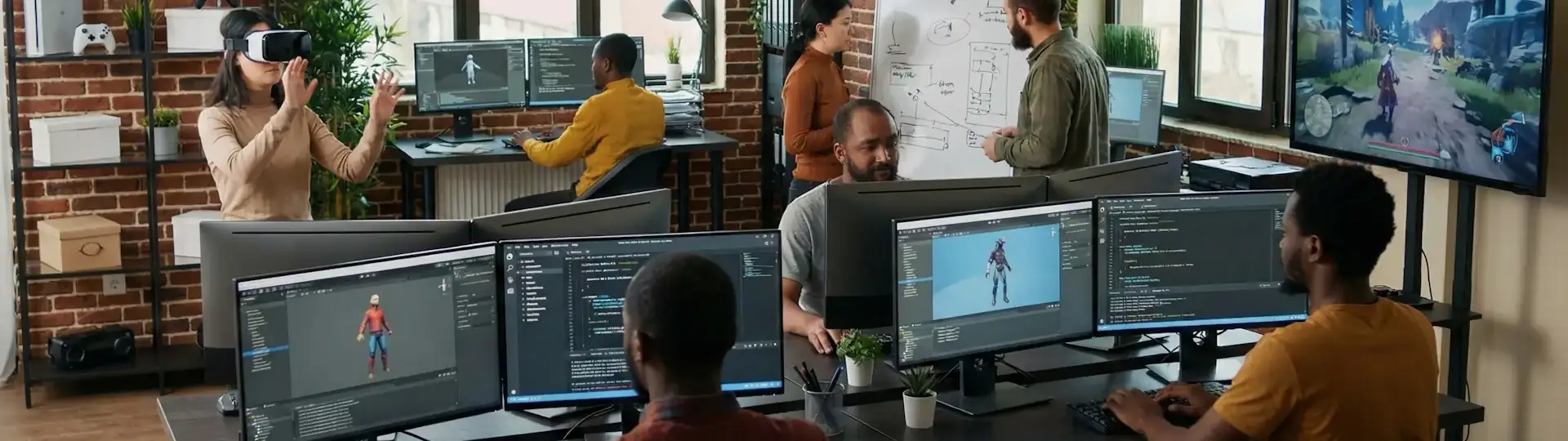


At some point, every game studio faces the same question: we need more capacity, but how do we get it?
The answer is not always obvious. Hiring full-time is the default assumption, but it is not always the right one. Freelancers are fast but introduce coordination overhead. Co-development partners sit somewhere in between.
Having worked across all three models (as full-time employees at Jagex, as freelance contractors, and now as a co-development partner) we have seen the tradeoffs up close. This post breaks them down honestly.
Option 1: Full-Time Hires
How It Works
You recruit developers onto your payroll. They work exclusively for your studio, embedded in your team.
Pros
- Maximum alignment full-time employees are invested in your project's long-term success
- Institutional knowledge they accumulate deep understanding of your codebase, tools, and culture
- Always available no competing clients or project conflicts
- Easier IP protection employment contracts typically include comprehensive IP assignment
Cons
- Slow to ramp recruitment takes 2-4 months. A senior Unity developer in the UK market is in high demand.
- Expensive fixed cost salary, benefits, equipment, office space. Senior Unity roles in London are commonly advertised at £60,000 to £90,000 a year before overheads. That cost persists whether the project needs them or not.
- Hard to scale down when the project ships, you are still paying the team. Redundancies are expensive, slow, and damaging to morale.
- Skills gaps your hire might be strong in gameplay but weak in networking. Covering all specialisms requires multiple hires.
When It Works Best
- Long-running projects (2+ years) with consistent headcount needs
- Core team roles where institutional knowledge is critical (lead engineer, technical director)
- Studios with a pipeline of sequential projects that keep the team fully utilised
Option 2: Freelancers
How It Works
You engage individual contractors for specific tasks or time periods. They work remotely, often juggling multiple clients.
Pros
- Fast to engage a good freelancer can start within days
- Flexible cost you pay only for the hours or deliverables you need
- Specialist skills need a shader programmer for 3 weeks? A freelancer is the right tool
- No long-term commitment when the work is done, the engagement ends
Cons
- Coordination overhead every freelancer needs onboarding, context, and management. Multiple freelancers multiply this cost.
- Variable quality the freelance market ranges from exceptional to unreliable. Vetting takes time.
- No team dynamics freelancers optimise for their deliverable, not the project as a whole. Integration issues are common.
- Availability risk your preferred freelancer may be unavailable when you need them
- Knowledge loss when the contract ends, their understanding of your codebase leaves with them
When It Works Best
- Short, well-defined tasks (shader work, audio integration, specific tool development)
- Surge capacity for crunch periods
- Highly specialised skills you need temporarily
- Early prototyping where the team structure is not yet defined
Option 3: Co-Development Partners
How It Works
You engage an external studio that embeds a team into your project. They operate as an extension of your in-house team, using your tools, attending your standups, and contributing to your codebase.
Pros
- Team, not individuals you get a coordinated unit with complementary skills. At Ocean View Games, our co-development engagements typically include engineering, QA, and technical art capabilities.
- Fast ramp-up an established team has worked together before. No forming/storming/norming period.
- Scalable scale the team up for production sprints, down for content phases. The co-dev partner absorbs the bench cost, not you.
- Battle-tested processes a co-dev partner brings their own methodology and quality standards, not just warm bodies
- Risk sharing the partner has a reputation stake in the project's success. Poor work loses them future business.
Cons
- Higher day rate than freelancers you are paying for coordination, process, and reliability, not just keystrokes
- Less control than full-time hires the team has their own working patterns and tools preferences
- IP considerations requires clear contractual agreements about code ownership and confidentiality
- Cultural fit the partner's working style needs to mesh with yours. A mismatch creates friction.
When It Works Best
- Projects with defined scope and timeline (6-18 months)
- Studios that need to scale rapidly without permanent headcount increase
- Overflow capacity when your in-house team is at full stretch
- Specialised domains (mobile porting, multiplayer networking, educational games) where the partner has deep expertise your team lacks
Key Takeaway: Co-development is not "outsourcing." Outsourcing implies throwing work over a wall. Co-development means embedding a team that operates as part of yours.
The Real Comparison
| Factor | Full-Time Hire | Freelancer | Co-Dev Partner |
|---|---|---|---|
| Ramp-up time | 2-4 months | Days | 1-2 weeks |
| Monthly cost | £5,000-8,000+ | Variable | Scoped per project |
| Commitment | Permanent | Per-task | Per-project |
| Scale flexibility | Low | High | High |
| Knowledge retention | High | Low | Medium |
| Quality consistency | Depends on hire | Variable | High (team reputation) |
| Management overhead | Low (once onboarded) | High (per freelancer) | Low (self-managing team) |
Comparison at a Glance
Here is how the three team scaling options compare across the factors that influence your decision:
| Factor | Freelancer | Co-Dev Studio | Full-Time Hire |
|---|---|---|---|
| Cost (short-term) | ✅ Pay per task | ⚠️ Scoped per project | ❌ Salary + overheads from day one |
| Cost (long-term) | ⚠️ Adds up over time | ✅ Scales with project phases | ✅ Predictable fixed cost |
| Accountability | ⚠️ Individual, variable | ✅ Team reputation at stake | ✅ Embedded in your culture |
| Scalability | ✅ Engage and release quickly | ✅ Scale up or down per sprint | ❌ Redundancies are slow and costly |
| Domain expertise | ⚠️ Depends on individual | ✅ Specialist teams available | ⚠️ Limited to your hire's skills |
| IP control | ⚠️ Requires careful contracts | ⚠️ Requires clear agreements | ✅ Employment contracts cover IP |
| Onboarding time | ✅ Days | ✅ 1-2 weeks | ❌ 2-4 months (recruitment + ramp) |
A Hybrid Approach
In practice, the best studios use a combination. A common pattern we see among our clients:
- Core team (full-time) - technical director, lead designer, producer. These roles require deep institutional knowledge and long-term investment.
- Production capacity (co-dev partner) - the bulk of engineering and QA work during production sprints. Scales up and down with project phases.
- Specialists (freelancers) - short-term engagements for highly specific skills (localisation, soundtrack, trailer editing).
This hybrid model gives you the alignment of full-time staff, the flexibility of freelancers, and the coordinated capacity of a co-dev partner.
How We Work as a Co-Dev Partner
At Ocean View Games, our co-development model typically involves:
- Embedded integration we join your Slack, attend your standups, commit to your repo
- Complementary skills we bring Unity engineering, mobile optimisation, and QA capabilities
- Transparent communication bi-weekly sprint reviews with playable demos
- Clean handoff when the engagement ends, you receive clean, documented code with no lock-in
If you want a number rather than a description, our co-development cost estimator turns a team size, a duration, and a days-per-week commitment into monthly and total figures, ex and inc VAT, with every assumption shown on screen.
Our work with Domi Online is a prime example. We joined as technical partners, grew with the project, and now operate as the core development team; a relationship that started with a code review and expanded based on trust and demonstrated capability.