
Nobody starts a game studio planning to ask for help. You build your team, define your vision, and set out to deliver something great. But game development is unpredictable. Scope creeps. Key people leave. Publisher milestones arrive faster than anticipated. Technical challenges turn out to be harder than the prototype suggested.
At some point, many studios face a critical decision: do we push our existing team harder, or do we bring in external support?
The answer is not always obvious. Asking for help too early wastes money. Asking too late puts the project at risk. At Ocean View Games, we operate as a co-development partner for studios ranging from funded startups to established mid-size teams. We have seen the patterns that indicate when a studio genuinely needs external support - and we have also seen studios bring in help they did not need.
This post covers the five clearest signals that it is time to bring in a co-development partner, explains what co-development actually means (it is not outsourcing), and offers guidance on how to make the partnership work.
First: Co-Development Is Not Outsourcing
These terms are used loosely in the industry, but they describe fundamentally different relationships. Understanding the distinction matters because it affects how you scope the engagement, how you manage communication, and what results you can expect.
Outsourcing
Outsourcing means handing off a defined piece of work - a set of 3D character models, a batch of level designs, a completed feature - to an external team that works independently and delivers the finished product. Communication is typically at the handoff points: briefing, review, revision, delivery.
Outsourcing works well for well-defined, self-contained deliverables where the external team does not need deep context about the rest of your project.
Co-Development
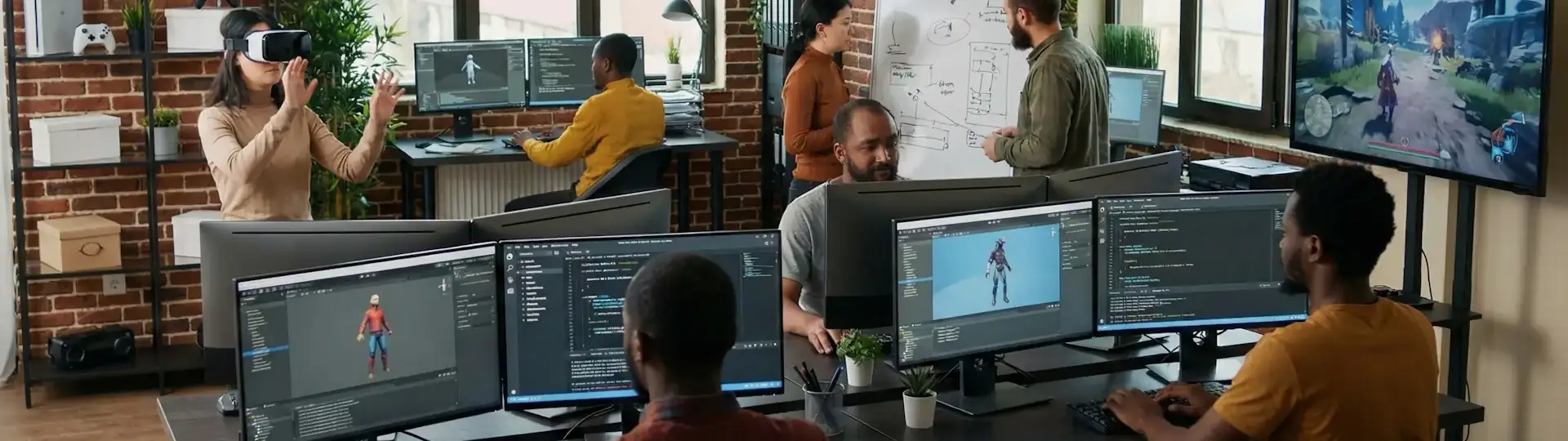
Co-development means embedding external developers directly into your team. They attend your stand-ups, work in your Jira, push to your repo, and follow your coding standards. From a day-to-day workflow perspective, they are indistinguishable from your internal developers.
Co-development works well for complex, interdependent work where the external team needs to understand your architecture, collaborate with your engineers in real time, and make decisions that affect other systems.
For embedded engineering engagements, we use a co-development model. When we partnered with Domi Online to build their MMORPG infrastructure, we did not deliver a "networking module" in isolation. We acted as the core engineering team - building combat systems, skill progression, multiplayer networking, and environment rendering as an integrated whole. As Domi Online's CEO put it: "There would be no Domi Online without their expertise."
Key Takeaway: Use outsourcing for well-defined, self-contained deliverables. Use co-development when the external team needs to work inside your architecture and make decisions alongside your developers.
Sign 1: You Are Missing Milestones
This is the most visible and most urgent signal. If your team is consistently missing sprint commitments, your vertical slice date keeps slipping, or your publisher is sending increasingly concerned emails about the Alpha delivery, something has to change.
Why Milestones Slip
In our experience, milestone slippage in game development usually comes from one of three root causes:
-
Underestimated scope. The feature list was defined before technical unknowns were fully understood. Networking code took three times longer than estimated. The AI system required a complete rewrite.
-
Technical debt compounding. Early prototyping decisions ("we'll clean this up later") are now slowing every subsequent feature. Adding new content takes twice as long because it keeps breaking existing systems.
-
Team capacity mismatch. The project plan was written for a team of eight, but attrition or hiring delays mean you are running with five.
How Co-Development Helps
A co-development partner provides experienced capacity much faster than the 2-3 month lead time of traditional hiring, once codebase access and onboarding are confirmed. We bring senior engineers who can navigate complex codebases and start contributing production-ready code within the first sprint.
When we work as an embedded team, we adopt your sprint cadence and take ownership of specific features or backlog items. This directly reduces the load on your internal team and helps you recover missed milestones without burning out the people you already have.
Sign 2: You Have a Critical Skill Gap
Game development requires a breadth of technical skills that few small or mid-sized studios have fully in-house. You might have strong gameplay programmers but nobody who owns performance, mobile platform work, legacy modernisation, build pipelines, or a difficult architectural problem that cuts across the whole project.
Common Skill Gaps We Fill
-
Mobile performance Desktop developers moving to mobile can underestimate thermal limits, memory pressure, battery use, touch input, and device variation. These problems benefit from mobile-specific expertise.
-
Legacy code and architecture An older Unity project can be commercially valuable while still being difficult to change safely. A fresh pair of senior eyes can identify where to stabilise, refactor, or isolate risk before feature work continues.
-
Platform integration and porting Store SDKs, save systems, input, achievements, content delivery, and platform requirements all introduce work outside the core game loop.
-
Live operations and tooling Telemetry, remote configuration, content pipelines, and operational tooling require a different mindset from simply getting a build to launch.
The Alternative Is Expensive
Hiring for a specialist role can take months once sourcing, interviews, notice periods, and onboarding are included. If the gap is project-specific, a permanent hire may not be the right investment anyway. Co-development lets you add the capability for the period where it is actually needed.
A co-development partner gives you access to senior specialists for the period you need them without committing to a permanent hire. There is still onboarding, but relevant experience can keep that ramp-up focused.
Sign 3: A Publisher Deadline Is Approaching
Publisher relationships are built on trust, and trust is built on delivery. When you have committed to a milestone date - a vertical slice for a greenlight review, an Alpha build for a trade show, a content update for a seasonal event - missing that date has consequences beyond the immediate project.
The Pressure Compounds
Late deliveries do not just delay revenue. They erode publisher confidence, which can affect:
- Approval for additional funding tranches
- Marketing support and featuring commitments
- Future project greenlight decisions
- The overall perception of your studio as a reliable partner
How to Scope a Rescue Engagement
When studios approach us with an imminent deadline, we follow a rapid triage process:
- Assess the gap. What specifically is not done? What is the minimum viable delivery that satisfies the milestone requirements?
- Identify parallelisable work. Which outstanding tasks can an external team take on without blocking your internal team?
- Define integration points. How will our code merge into your project? What are the coding standards, branching strategy, and review process?
- Execute. Once access and onboarding are sorted, we aim to be set up in your environment and pulling tickets within days rather than weeks. The exact timeline depends on how quickly access can be granted and how complex the codebase is.
The key is acting early. If you can see a deadline becoming unrealistic two months out, that is the time to engage a co-development partner - not two weeks before the due date.
Key Takeaway: A co-development partner is most effective when engaged early enough to make a meaningful impact. The worst time to ask for help is when it is already too late.
Sign 4: Your Team Is Burning Out
Crunch is the industry's worst-kept secret. Extended periods of overtime, weekend work, and sustained high pressure lead to reduced code quality, increased bugs, declining morale, and - ultimately - people leaving.
The Hidden Cost of Burnout
The financial impact of developer burnout is severe and often underestimated:
- Attrition. Replacing a senior developer carries recruitment cost, onboarding time, and a productivity gap while the replacement learns the project.
- Bug rates increase. Tired developers write buggier code. The resulting QA burden and rework cycle further extends timelines.
- Decision quality degrades. Architectural decisions made under sustained pressure tend to prioritise short-term expedience over long-term stability. This creates technical debt that compounds over the life of the project.
- Creativity suffers. Game development is a creative discipline. Exhausted teams produce safe, uninspired work. The spark that makes a game special gets ground down by sustained overwork.
How Co-Development Relieves Pressure
Bringing in an embedded co-development team does not add management overhead for your leads - not if the partner is experienced. Senior co-development engineers should be self-directed within your sprint framework. They take tickets, submit pull requests, and participate in reviews like any other team member.
The immediate effect is that your internal team's workload drops to sustainable levels. Features that were being deferred because nobody had capacity start moving again. People get to work regular hours. Code quality improves. Morale recovers.
This is not a luxury. It is a strategic investment in the sustainability of your team and your project.
Sign 5: You Need to Scale for Live Operations
Shipping the game is a milestone, not the finish line. For live-service games, the real work begins at launch: daily content operations, seasonal events, server monitoring, bug fixes, platform updates, community management, and ongoing optimisation.
The Live-Ops Capacity Problem
During development, your entire team is focused on building the game. At launch, that same team needs to simultaneously:
- Fix critical bugs reported by players
- Deploy hotfixes without introducing regressions
- Develop and ship the first post-launch content update
- Monitor server performance and scale infrastructure
- Respond to platform-specific issues (iOS update breaks something, Google Play policy change requires compliance updates)
- Begin pre-production on the next major update
This often creates a step-change in workload just as the team is trying to stabilise the launch.
The Co-Development Solution
A common and effective pattern is to engage a co-development partner specifically for live operations support. Your internal team focuses on the next major content milestone while the co-development team handles:
- Bug triage and fixing Addressing player-reported issues and crash reports
- SDK and platform updates Keeping third-party SDKs current and maintaining store compliance
- Technical debt reduction Refactoring systems that were rushed to ship, improving stability for the long term
- Seasonal content implementation Building and deploying time-limited events based on your design team's specifications
This split allows your internal team to remain focused and creative while the live game receives the attention and stability it needs to retain players.
Making Co-Development Work
Bringing in an external team is only effective if the integration is handled well. Here is what we have learned from our engagements:
1. Treat Them Like Internal Team Members
The biggest mistake studios make is treating co-development partners as vendors. If your external developers are excluded from architecture discussions, design reviews, and retrospectives, they cannot make informed decisions. They end up producing code that technically meets the ticket requirements but does not align with the broader vision.
Give them the same access to information, the same voice in meetings, and the same accountability as your internal developers.
2. Invest in Onboarding
Even senior developers need context. Spend time walking through your architecture, explaining design intent, and sharing the unwritten conventions that every codebase accumulates. A day or two of thorough onboarding saves weeks of misalignment.
3. Establish Clear Code Standards
Provide your style guide, naming conventions, branching strategy, and PR review process upfront. At Ocean View Games, the first thing we do on any co-development engagement is review the client's coding standards and ensure every line we write matches their project's conventions. When we leave, there should be no way to tell which code we wrote.
4. Define Ownership Boundaries
Be explicit about which systems or features the co-development team owns. Ambiguous ownership leads to duplicated effort and merge conflicts. Clear boundaries allow both teams to work in parallel with confidence.
5. Plan the Handover
Every co-development engagement should have a defined exit plan. We document every system we build, comment our code thoroughly, and provide technical handover sessions to ensure your internal team can maintain and extend our work without confusion. Zero lock-in is a core principle - if our engagement ends, your team picks up exactly where we left off.
Is It Time?
If you recognise one or more of these signs in your studio, it is worth having the conversation. Not every situation requires a co-development partner - sometimes the answer is a scope reduction, a timeline extension, or a targeted hire. But when capacity, expertise, or timeline pressures exceed what your internal team can sustainably handle, a co-development partnership is the most effective way to bridge the gap.
At Ocean View Games, we work with game studios and funded startups as embedded Unity engineering teams. We join your workflow, adopt your standards, and deliver production-ready code from the first sprint. Our team brings senior-level experience from projects including Domi Online and RuneScape Mobile - complex, high-stakes codebases where quality and reliability are non-negotiable.
If you want to explore whether co-development is the right model for your current project, reach out to our team. We are happy to discuss your situation, even if the conclusion is that you do not need us yet.